


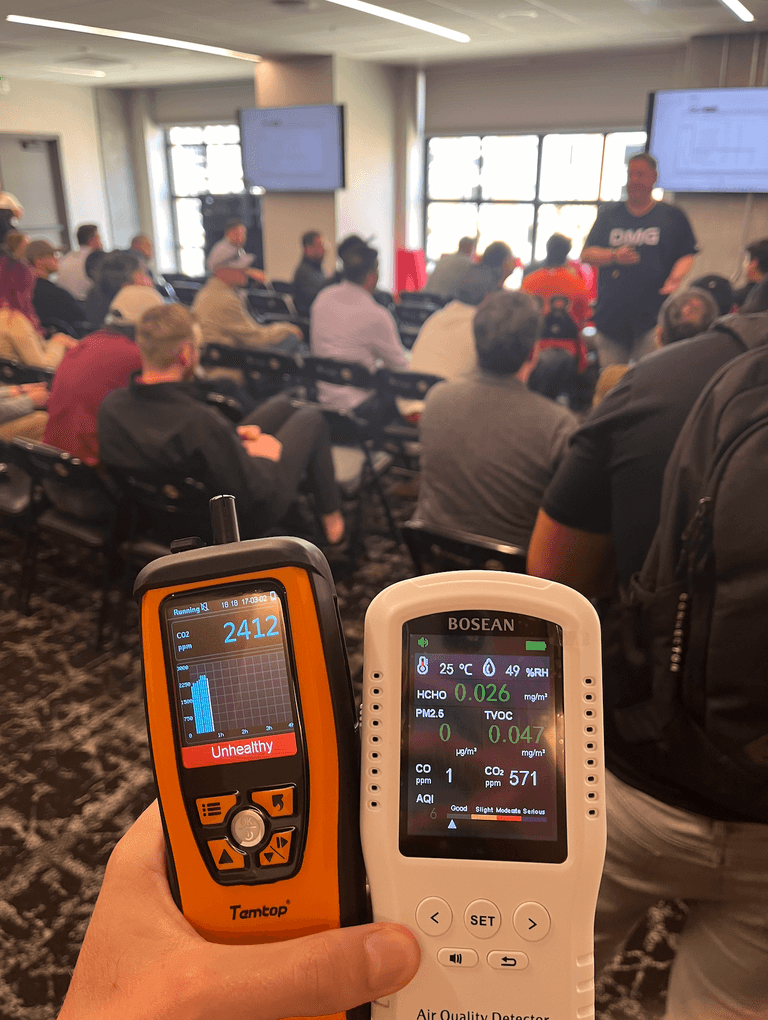
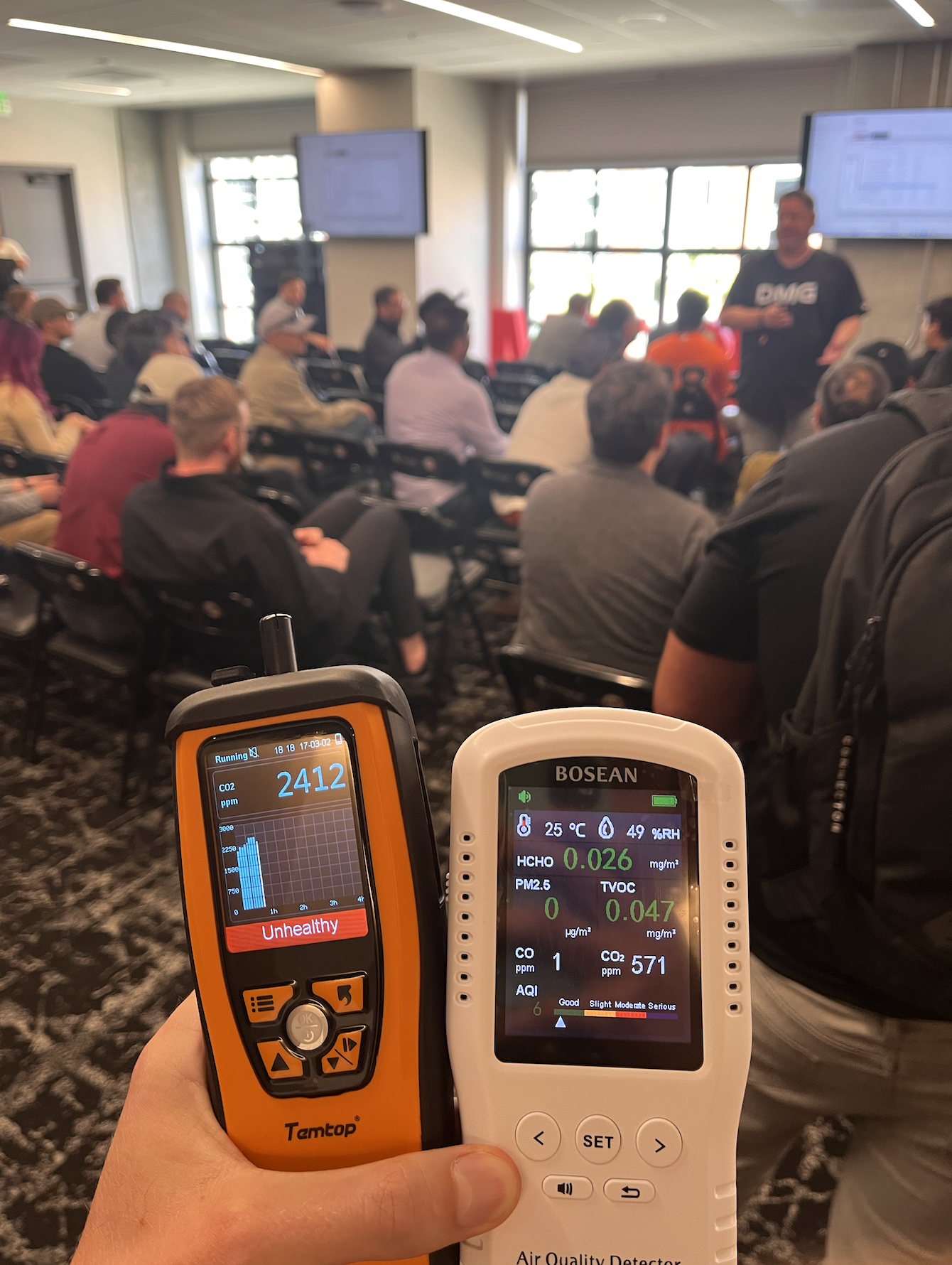
My CO2 sensor read 2400ppm (very unhealthy), theirs read 570ppm (outside air quality)
HVAC engineers didn't trust my high CO2 readings despite better sensor quality
Started on May 21, 2025
Updated on September 23, 2025
I walked into a room filled with 50 people, full of ventilation contractors and HVAC engineers. I was wearing a mask. Even through my mask I could feel the stuffy breath around me. I was curious and pulled out my CO2 sensor (Temtop M2000), measured and then shared with the room my readings.
I shared my readings with the room during a presentation on the health effects on poor indoor air quality.
I watched skepticism spread as it showed 2400ppm CO2. The other engineer's sensor read a comfortable 570ppm.
"We would fall over fainting if CO2 levels were as high as 2400." they said.
Everyone in the room knew that levels above 1100 are unhealthy and illegal. Yet, probably almost no one had experience of what it's like to be exposed to extra high CO2 levels.
So... I looked into the difference of CO2 sensors. Did I have a good CO2 sensor, or was it broken?
The Critical Difference
My Temtop M2000: Uses a dedicated Swedish SenseAir NDIR sensor that actually measures CO2 directly. Research-adjacent quality with ±50ppm + 5% accuracy.
Their Bosean T-Z01Pro: Doesn't measure CO2 at all—it estimates CO2 by doing math on TVOC sensor readings.
I have more notes on my sensor here: RESEARCH-TEMTOP-M2000-2nd
What likely happened:
My sensor was likely accurate. The room genuinely had poor ventilation with many people in a small room. Their sensors gave false confidence because they weren't actually measuring CO2, their sensor only inferred a value from other sensors.
I don't know what the HVAC system's CO2 sensor measured, but it was likely broken or the system didn't have capacity to provide enough outdoor air to the room.
Personal Reflection
I've measured CO2, formaldehyde, and particles in many indoor and outdoor places. Most people are unable to feel the effects of poor air quality on their body. I could speculate why this is, but I have learned from my own body that when I feel bad in my body, it is harder to feel the effect of air quality. Poor air quality makes me feel noxious, but if I already feel noxious from looking at a screen for 7 hours, drinking two coffees and smoking a cigarette, I will likely not feel the effect of high CO2 levels.
+ I wore a mask!
Most people who wear masks a few years after the COVID surge are familiar with the phenomenon that wearing a mask raises additional skepticism in people. I know from many conversations about chemical sensitivities that the vast majority of people believes that others "exaggerate to be in the spotlight" instead of actually being impacted by poor air quality.